

News
What Keeps a Complex Aircraft Repair Moving?

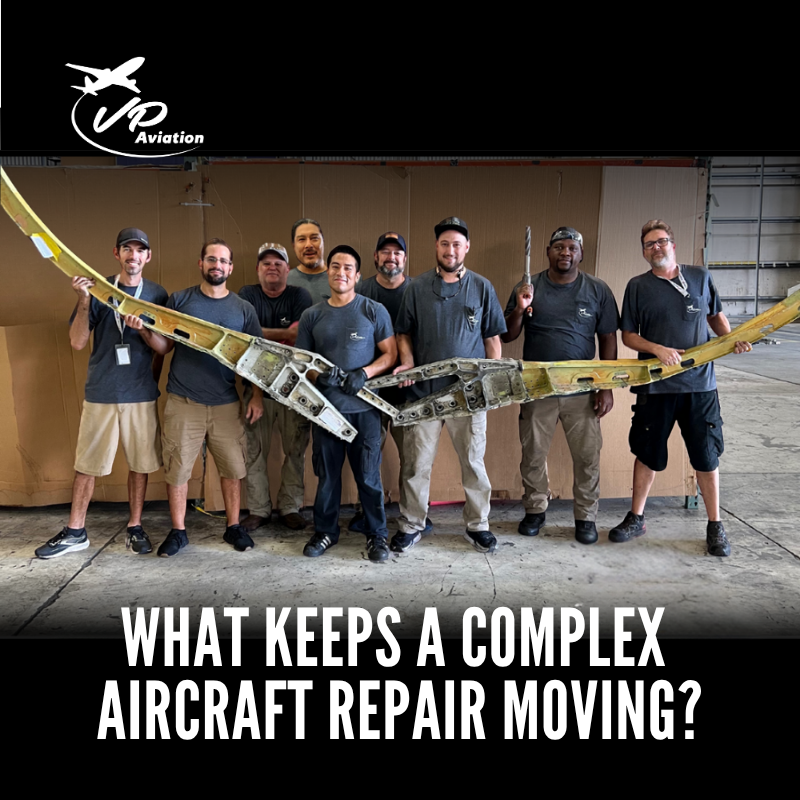
What Keeps a Complex Aircraft Repair Moving?
What keeps a complex aircraft repair moving? A double pickle fork replacement on a B737 by VP Aviation’s Mobile Response Team gives us a heck of a case study.
And the answer isn’t better mechanics.
That’s too easy and, frankly, disrespectful to everybody else doing this work.
There are experienced aircraft maintenance professionals working on complex repairs every day. What keeps one of those projects moving goes beyond the experience of any one person.
It’s how the crew works together, how the project is prepared and how everyone involved stays connected through the repair.
A complex aircraft repair takes a crew that knows each other
A complex repair isn’t the time to figure out how a crew is going to function as a team.
When people have been through major projects together, they know each other’s strengths. They know how to divide the work, communicate when something changes and recognize when someone needs another set of hands.
That familiarity matters when the work gets complicated. The crew already has a way of working together they can count on.
Structures and mechanical work stay connected
A major structural repair doesn’t stay neatly inside one discipline.
Structures Mechanics, A&P Mechanics, inspection, engineering and customer personnel all have a role. One part of the work affects what happens next.
The handoffs matter.
Keeping those disciplines connected helps everyone understand what’s ready, what needs attention and what has to happen before the next phase can begin.
Planning a complex aircraft repair starts before the first wrench turns
The right tooling and manpower need to be in place. Sequencing, access, customer coordination and engineering support need attention before they become immediate needs on the aircraft.
Knowing the repair is one thing. Knowing what it’s going to take to move that repair from open to close is another.
Preparation gives the crew a clear path into the work and helps keep that path open as the project progresses.
Experience changes what people see coming
Someone who’s been through a major structural project recognizes where a job can bog down before it does. They know which questions to ask early and which details could affect the work several steps ahead.
That doesn’t mean there won’t be surprises. It’s aircraft maintenance.
But experience changes what you see coming and how quickly you know what needs to happen next.
Experience isn’t just about the individual. It’s about how the team performs together.
The customer is part of the equation
Even a phenomenal outside team can’t operate in a vacuum.
Customer representatives, engineering, inspection, documentation, parts, access and approvals all play a part.
The outside crew must know how to work with the customer’s operation, not around it. That means communicating what’s needed, understanding the customer’s requirements and staying coordinated as the repair progresses.
The working relationship is part of what keeps the work moving.
Fourteen days doesn’t happen by accident
A closer look at the hands-on work behind those 14 days.
We recently saw all those pieces come together during a double pickle fork replacement on a B737.
A VP Aviation Mobile Response Team handled the project from start through final rigging, including both the structural and mechanical work.
The job was completed in 14 days.
This wasn’t a group of mechanics meeting for the first time on the aircraft. It was an established MRT crew with Structures and A&P Mechanics who had worked together before and knew the work.
The team arrived prepared, worked alongside the customer’s personnel and carried the project through each phase of the repair.
Fourteen days is a completion time worth talking about. But the story behind that number matters.
It wasn’t about asking mechanics to work faster.
It was about having the right team in place and giving them what they needed to do the work.
As VP Aviation co-owner and VP of Technical Operations Benji Farr puts it:
“I would put them up against anybody in the world. It shows in their workmanship, their attitude, everything about it speaks for itself.”
We think this project speaks for itself, too.
It’s also a look at what VP Aviation’s Mobile Response Teams bring to structural and mechanical repairs, modifications, AOG recovery and Special Projects: experienced technicians who know how to work together and alongside the customer’s team.
Have a project coming up? Explore our AOG Support and Special Projects capabilities, or contact our team at sales@vpaviation.net or 813-358-3359.


